You’ve decided it’s time to get visiting cards printed. Maybe you’re launching a new business, attending a trade event, or simply tired of scribbling your number on scraps of paper. But then the questions start piling up: What size should I choose? Which paper is best? Should I go matte or glossy? How many should I order? And what exactly goes on the front?
These are the exact questions that trip up first-time buyers — and even experienced buyers who want to upgrade to something more premium. This guide answers every major question about visiting cards, from paper and finishes to file preparation and turnaround times. Whether you’re a shop owner in Vastral, a startup founder in Odhav, or a professional in Ahmedabad looking to make a stronger first impression, you’ll find everything you need right here.
Why Getting Your Visiting Card Right Matters More Than You Think
A visiting card is often the first physical thing someone receives from you. Before they visit your website, before they follow you on social media, they hold your card in their hand. That small rectangle of paper communicates your professionalism, your attention to detail, and your brand — all in about three seconds.
Yet many people treat visiting cards as an afterthought. They rush the design, choose the cheapest option, and end up with cards that feel flimsy, look generic, or contain outdated information. The result? Cards that get tossed instead of kept.
The good news is that getting it right isn’t complicated. You just need to understand a few key decisions before you place your order. That’s exactly what this FAQ is designed to help you do.
What Is the Standard Size for a Visiting Card?
The global standard size for a visiting card is 3.5 x 2 inches (88.9 x 50.8 mm). This is the size that fits neatly into a wallet, a cardholder, or a standard business card slot. It’s the size most people expect, and it’s the safest choice for most professionals and businesses.
That said, there are popular alternatives worth knowing about:
- Square cards (2.5 x 2.5 inches): Eye-catching and modern, often used by designers, photographers, and creative professionals. They stand out in a stack but don’t fit standard cardholders.
- Mini cards (3.5 x 1 inch): Compact and distinctive, popular for social media handles or simple contact details. Not ideal if you need to include a lot of information.
- Folded cards (3.5 x 4 inches, folded to 3.5 x 2): Offer extra space for services, maps, or QR codes. Great for businesses with multiple offerings.
What About Bleed and Safe Zone?
If you’re preparing your own design file, you need to know two terms. The bleed area is an extra 3mm border around your card that gets trimmed off during cutting — any background color or image should extend into this area so there are no white edges after trimming. The safe zone is the inner area (about 3mm from the trim edge) where all important text and logos should sit, so nothing gets accidentally cut off.
If you’re working with a designer or a local print shop like Shree KP Kumar, they’ll handle this setup for you. But it’s useful to understand these terms when reviewing your proof.
What Paper Types Are Used for Visiting Cards?
The paper you choose affects how your card feels in someone’s hand, and that feeling matters. Here are the most common paper types used for visiting cards:
-
Art Card / Coated Paper (300, 400 GSM): The most popular choice. It’s smooth, takes color beautifully, and feels solid without being overly thick. Most standard visiting cards are printed on 350 GSM art card.
-
Matte Laminated Paper: A coated card with a soft matte lamination applied on top. It has a premium, velvety feel and resists fingerprints. Excellent for a sophisticated, understated look.
-
Glossy Laminated Paper: Bright, shiny, and vibrant. Colors pop on a glossy surface, making it ideal for bold, colorful designs. Slightly more prone to fingerprints.
-
Textured / Uncoated Paper: Has a natural, slightly rough feel. Often used for eco-friendly or artisanal brand aesthetics. Ink can appear slightly less vibrant compared to coated stock.
-
Thick Premium Boards (800 GSM): Created by laminating two sheets together. These feel noticeably heavy and luxurious, the kind of card people don’t throw away.
What Does GSM Mean?
GSM stands for grams per square metre, it’s the measure of paper weight and thickness. The higher the GSM, the thicker and heavier the paper. For visiting cards, anything below 250 GSM will feel thin and cheap. Most quality cards start at 350 GSM, with premium options going up to 800 GSM or more.
Understanding how paper type affects your printing cost can help you make a smarter decision when balancing quality and budget.
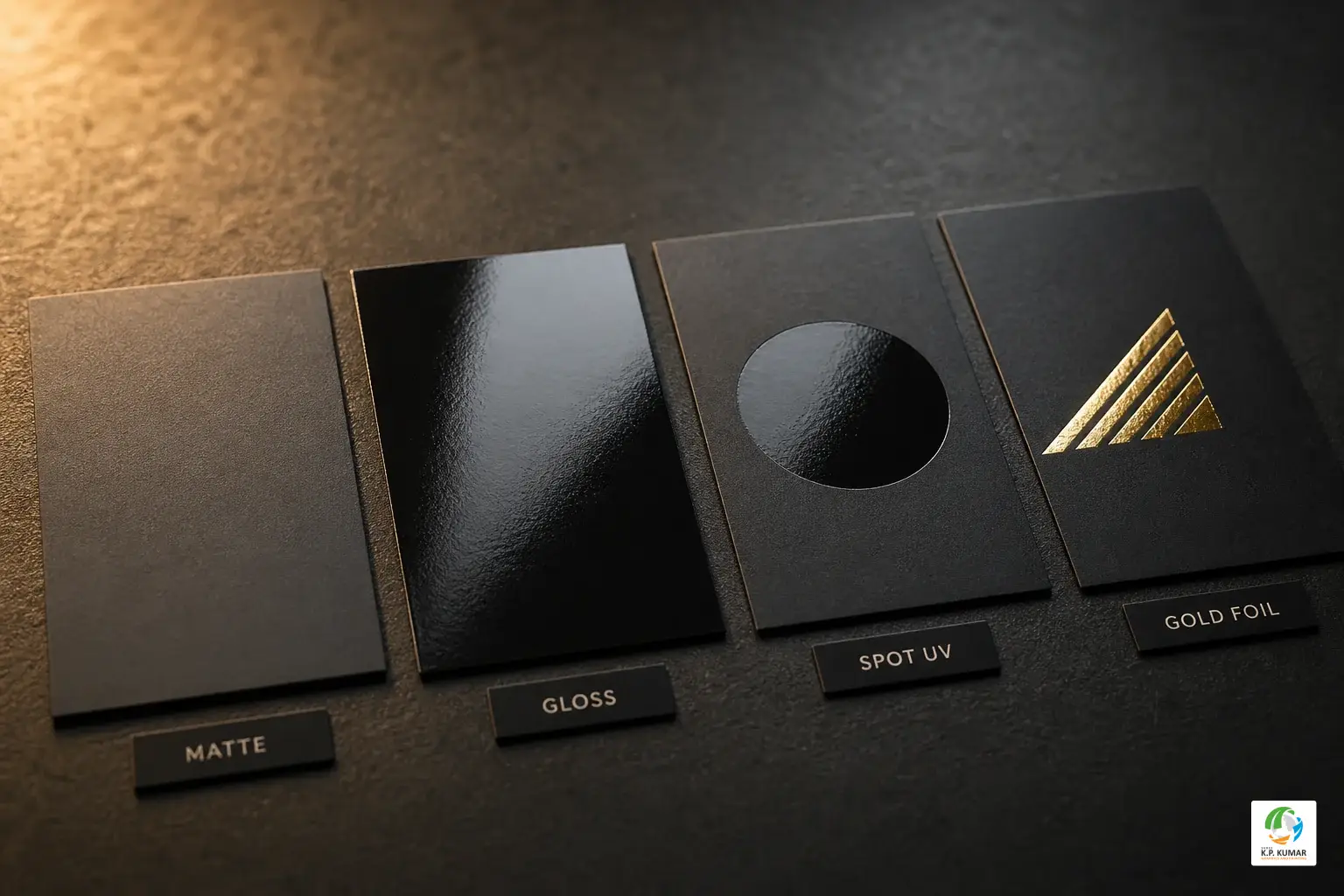
Matte, Glossy, Spot UV, Gold Foil, Embossing, Which Finish Should You Choose?
The finish on your visiting card is what makes it memorable. Here’s a clear breakdown of each option so you can choose what suits your brand best.
Matte Finish
A matte finish gives your card a smooth, non-reflective surface. It looks refined and professional, and it’s easy to write on (useful if you want to jot a note on the back). Matte cards tend to feel more premium than glossy ones, even at similar price points. Best for: lawyers, consultants, architects, and anyone projecting a serious, trustworthy image.
Glossy Finish
A glossy finish is shiny and reflective, making colors appear more vivid and saturated. It’s the most common finish for standard visiting cards and works well for bold, colorful designs. Best for: retail businesses, restaurants, event planners, and anyone with a vibrant brand identity.
Spot UV
Spot UV applies a selective high-gloss coating to specific parts of the card, your logo, your name, or a design element, while the rest of the card remains matte. The contrast between the two surfaces creates a striking visual and tactile effect. Best for: premium brands, real estate professionals, and anyone who wants their card to feel interactive.
Gold Foil and Silver Foil Stamping
Foil stamping uses metallic foil (gold, silver, rose gold, or other colors) pressed onto the card surface using heat and pressure. The result is a brilliant, mirror-like metallic accent that catches light dramatically. Best for: jewellers, luxury brands, wedding planners, and high-end service providers.
Embossing
Embossing raises selected elements (like your logo or name) above the card surface, creating a three-dimensional effect you can feel with your fingertip. This add a tactile quality that makes cards feel genuinely premium. Best for: boutique businesses, designers, and anyone in a competitive industry where standing out matters.
Quick tip: You can combine finishes for maximum impact, for example, a matte laminated card with spot UV on the logo and gold foil on the name. Just keep in mind that each additional finish adds to the cost and production time.
What Information Should You Put on a Visiting Card?
Less is more, but not too little. Here’s how to think about what goes on your card.
Essential Information (Always Include)
- Your full name, clearly readable, in a prominent font size
- Job title or designation, helps the recipient remember your role
- Company name and logo, your brand identity anchor
- Phone number, at least one, ideally with a WhatsApp icon if you use it for business
- Email address, professional domain email preferred (not Gmail/Yahoo for businesses)
Optional but Valuable
- Website URL, drives traffic and adds credibility
- Social media handles, relevant ones only (Instagram for visual businesses, LinkedIn for B2B)
- QR code, links to your website, portfolio, or digital card for easy scanning
- Physical address, useful for shops, clinics, and businesses with a walk-in location
- Tagline, a short, memorable phrase that captures what you do
What NOT to Include
- Too many phone numbers (pick one or two maximum)
- Outdated information, always update before reprinting
- Low-resolution or pixelated logos
- Tiny fonts below 7pt that become unreadable after printing
- Cluttered layouts that make the card hard to scan quickly
Using Both Sides of the Card
The back of your visiting card is valuable real estate that many people leave blank. Consider using it for a QR code, a map to your location, a list of key services, or a promotional offer. For businesses in Ahmedabad with multiple service lines, like printing, design, and branding, the back is a great place to list what you offer without crowding the front.
What Are the Minimum Order Quantities and Turnaround Times?
One of the most common questions from first-time buyers is: “How many do I have to order?” Here’s what you need to know.
Minimum Order Quantities (MOQ)
-
Standard visiting cards: Most print shops, including local ones in Ahmedabad, accept orders starting from 200 cards.
-
Premium finish cards (spot UV, foil, embossing): MOQ is typically higher, often 500 to 1000 cards, because setup costs for special finishes are significant.
-
Bulk corporate orders: 500, 1,000, 2,000, and 5,000+ cards are common for companies printing for entire teams or sales forces.
Ordering in bulk almost always reduces your per-card cost significantly. If you know you’ll need more cards within the next six months, it’s usually smarter to order a larger quantity now.
Turnaround Times
-
Standard visiting cards: 4, 5 business days once the design is approved
-
Premium laminated cards: 5, 6 business days
-
Special finish cards (foil, spot UV, embossing): 6, 7 business days depending on complexity
-
Bulk orders (1,000+): May require additional time; confirm with your printer
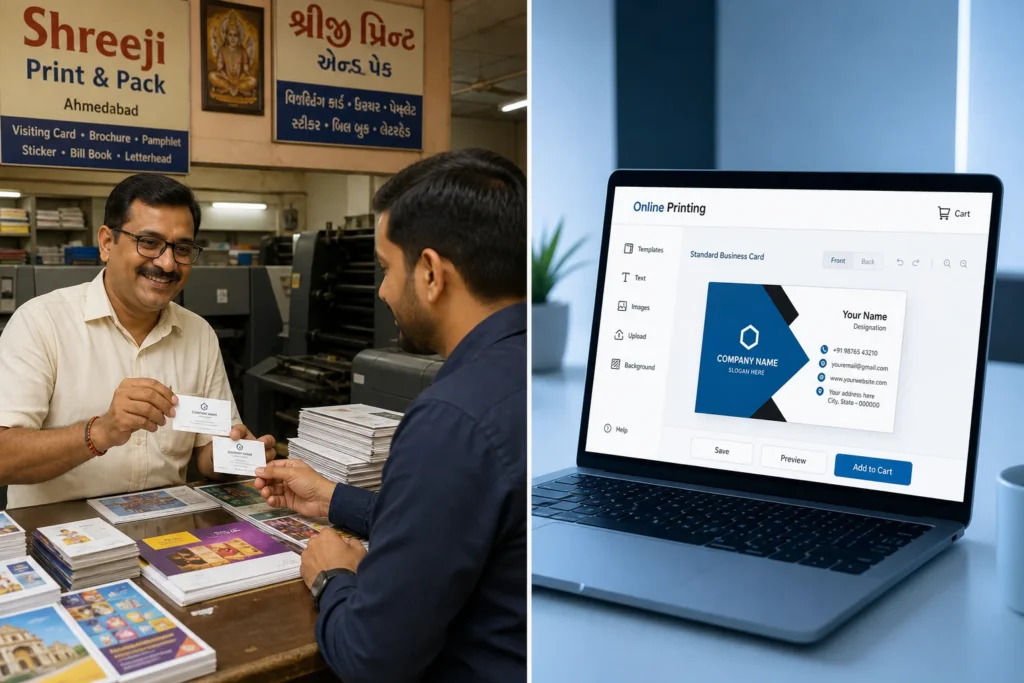
One clear advantage of working with a local print shop in Ahmedabad over an online platform is faster turnaround and the ability to collect your order in person. If you’re in Vastral, Odhav, Amraiwadi, or nearby areas, you can often get your cards the same day or next day for standard orders.
How Much Do Visiting Cards Cost to Print?
Printing cost for visiting cards varies based on several factors. Understanding these will help you budget accurately and avoid surprises.
Key Factors That Affect Price
-
Paper type and GSM: Thicker, premium paper costs more than standard art card.
-
Finish: Standard lamination is affordable; foil stamping and embossing add significant cost due to specialized equipment and setup.
-
Quantity: The more you order, the lower the per-card cost. Printing 1,000 cards is far more economical per unit than printing 200.
-
Single-sided vs. double-sided: Printing on both sides adds to the cost but often doubles the value of the card.
-
Design charges: If you need a design created from scratch, factor in graphic design fees. If you have a ready print-ready file, this cost is eliminated.
-
Urgency: Rush orders may carry a premium charge.
Smart buyer tip: Always ask your printer for a per-unit cost at different quantities (e.g., 200, 300, 500, 1,000). The difference is often dramatic, and ordering slightly more can save you money in the long run.
At Shree KP Kumar, we offer competitive pricing for visiting cards across all finish levels. Call us at 09714998311 or send us a WhatsApp message to get a quick quote based on your specific requirements.
How Should You Prepare Your File for Printing?
Even the best design can produce a disappointing result if the file isn’t prepared correctly. Here’s what your printer needs from you.
Preferred File Formats
- PDF (print-ready): The gold standard. Preserves fonts, colors, and layout exactly as designed.
- AI (Adobe Illustrator): Ideal for vector-based designs. Logos and text remain sharp at any size.
- CDR (CorelDRAW): Widely used by Indian print shops and designers.
- PSD (Photoshop): Acceptable if at 300 DPI and in CMYK color mode.
Avoid submitting designs in Word, PowerPoint, or low-resolution JPEG format. These formats are not suitable for professional printing and will result in blurry or pixelated output.
Resolution: 300 DPI Minimum
DPI stands for dots per inch, it measures image sharpness. For print, 300 DPI is the minimum. Images that look sharp on screen (which is typically 72, 96 DPI) will appear blurry when printed if they haven’t been created at 300 DPI. Always check your image resolution before sending files to print.
Color Mode: CMYK, Not RGB
Screens display colors using RGB (Red, Green, Blue). Printers use CMYK (Cyan, Magenta, Yellow, Black). If you submit an RGB file, the printer’s software will convert it, and the colors may shift noticeably, especially for blues, purples, and oranges. Always design in CMYK from the start, or ask your designer to convert before submission.
What If You Don’t Have a Design File?
No design? No problem. Shree KP Kumar offers in-house graphic design services for visiting cards. Our designers will create a professional layout based on your brand, preferences, and the information you provide. You’ll receive a proof for approval before anything goes to print.
Frequently Asked Questions About Visiting Cards
Can I print on both sides of a visiting card?
Yes, absolutely. Double-sided printing is a popular and cost-effective way to include more information without cluttering the front. The back can feature your services, a QR code, a map, or even a design element that reinforces your brand.
Can I get a sample before placing a bulk order?
At a local print shop, you can often request to see physical samples of paper types and finishes before committing to a large order. This is one of the biggest advantages of working with a local printer in Ahmedabad, you can touch and compare materials in person, which is impossible with online-only platforms.
What if I need a design created from scratch?
Simply bring your logo (if you have one), your contact details, and any color or style preferences. A professional designer will handle the rest. If you don’t have a logo yet, that can be designed as well.
Are visiting cards still relevant in 2026?
Absolutely. Despite the rise of digital networking, physical visiting cards remain one of the most effective networking tools. A well-designed card creates a tangible, memorable impression that a LinkedIn profile or digital contact simply cannot replicate. In face-to-face business settings, trade shows, client meetings, local markets, a visiting card is still expected and respected.
According to Statista’s research on business card usage, billions of business cards are printed globally each year, and physical cards continue to hold strong in markets where in-person business relationships are central, including India.
What’s the difference between visiting cards and business cards?
In practice, the terms are used interchangeably in India. “Visiting card” is the more commonly used term locally, while “business card” is the international standard. They refer to the same product: a small card carrying your contact and professional information.
How do I store and carry visiting cards properly?
Invest in a card holder or card case to keep your cards clean, flat, and presentable. Cards that are bent, scratched, or dirty make a poor impression. Store extras in a cool, dry place away from direct sunlight, which can cause colors to fade over time. Shree KP Kumar Graphics offers a free premium card holder with premium visiting card printing service.
What’s the difference between lamination and coating?
Lamination is a thin plastic film bonded to the card surface, it adds protection and a distinct feel (matte or glossy). Coating (like UV coating or aqueous coating) is a liquid applied to the surface and cured, it’s thinner than lamination and adds shine or protection without the same tactile thickness. Both serve to protect the card and enhance its appearance.
Can I order visiting cards with a QR code?
Yes, and it’s increasingly popular. A QR code on your visiting card can link to your website, your Google Business profile, your portfolio, or even a digital version of your card. Just make sure the QR code is large enough to scan easily, at least 2 x 2 cm on the printed card, and test it before approving the final proof.
Ready to Print Your Visiting Cards in Ahmedabad?
By now, you have a clear picture of every major decision involved in printing visiting cards: the right size, the best paper for your budget, which finish suits your brand, what information to include, how to prepare your file, and what to expect in terms of cost and turnaround time. The goal was to make sure you walk into the process with confidence, and avoid the costly mistakes that come from guessing.
If you’re based in Ahmedabad, whether in Vastral, Odhav, Amraiwadi, New Maninagar, Ramol, or anywhere nearby, Shree KP Kumar Graphics and Printing is your local partner for visiting cards that make a real impression. With over a decade of experience, 13,000+ clients served, and every finish option from standard matte to gold foil and embossing, we’re equipped to bring your vision to print, exactly the way you imagined it.
Don’t settle for generic cards from an impersonal online platform. Get expert guidance, physical samples, and fast local delivery when you work with a trusted print shop right here in Ahmedabad. WhatsApp us today to share your requirements and get a quick quote, or call us at 09714998311 to speak with our team directly. Your visiting cards are one of the most cost-effective branding investments you’ll make, let’s get them right.